Book of the Jewish Faith: Understanding the Torah, Tanakh, and Talmud
Explore the Torah, Tanakh, and Talmud to understand the sacred texts, traditions, teachings, and spiritual foundations of the Jewish faith.
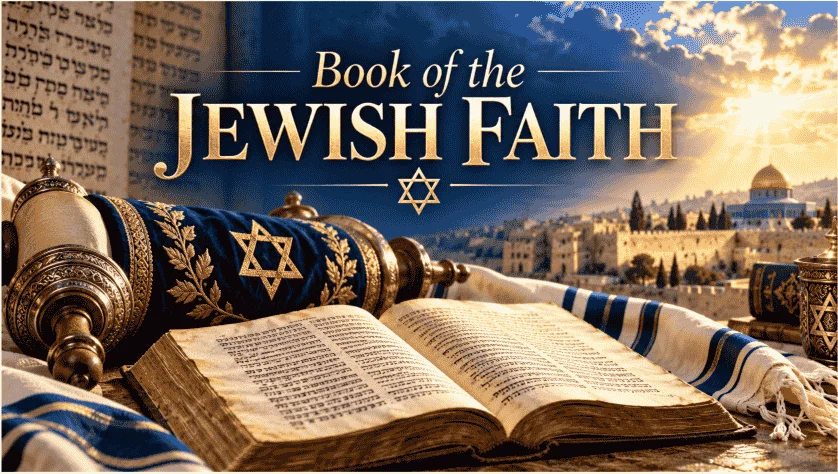
A scribe needs about a year to hand-write one Torah scroll, and a single wrong letter can make the whole thing unfit for use until it’s corrected. That kind of care tells you a lot about the book of the Jewish faith and how seriously the Jewish faith treats every word.
Still, ask which one text counts as “the” holy book and you’ll hear three names: Torah, Tanakh, and Talmud. They aren’t rivals. Each one does a different job.
Three Questions, Three Texts
The Jewish holy books fit together like this:
The Torah asks: what was commanded?
The Tanakh asks: how did the people live it out?
The Talmud asks: what do we do about it today?
Most Jewish religious texts grow out of one of these three, so let’s take them in order.
The Torah: One Scroll, Five Books
Jewish worship centers on the Torah, which is the smallest of the three. The Hebrew Bible's first five books are covered:
Genesis: creation, Noah, Abraham, and the family that becomes a nation
Exodus: the revelation at Sinai, the escape, and slavery in Egypt
Leviticus: priestly duties and rules for holy living
Figures: forty years of travel in the desert
Deuteronomy: Moses’ farewell speeches
“Torah” means “teaching.” Although the text contains stories, poetry, and family history, it is frequently translated as “law.” The 613 commandments (mitzvot) of Jewish tradition include things like paying employees on schedule and leaving a field's edges for the underprivileged.
The Torah is a handwritten scroll found in synagogues. It is written on parchment made from the skin of a kosher animal by a skilled scribe known as a sofer using a quill. To ensure that no one touches the text, readers follow along with a pointer known as a yad.
Weekly sections of the scroll are read. The cycle comes to an end on Simchat Torah, and the community begins anew with the first verse of Genesis.
The Tanakh: The Full Hebrew Bible
The name is an integrated map. Its three sections are denoted by T, N, and K:
1. Torah: the five books mentioned above
2. Nevi’im: the Prophets
3. Ketuvim: the Writings
Nevi'im follows Moses and the people. Samuel anoints kings, Joshua enters the country, and prophets like Isaiah and Jeremiah confront errant rulers.
The most intimate part is Ketuvim. Psalms, Proverbs, Job, the Song of Songs, Ruth, Esther, and Daniel are all contained within. Some books are love poems, some are prayers, and Job is a protracted, awkward debate about suffering.
According to Jewish tradition, there are 24 books in the Tanakh: eleven in the Writings, eight in the Prophets, and five in the Torah. The content of the Protestant Old Testament is identical, but it is organized differently and divided into 39 books. Additional books are added to Catholic and Orthodox Bibles.
So for the holy book of Judaism in its widest sense, the Tanakh is the answer.
The Talmud: Where Rabbis Argue
First-time readers are surprised by this one. It is neither a narrative nor a neat set of guidelines. It is a debate record.
Jewish tradition holds that the written Torah was accompanied by oral explanations that were passed down through the generations by teachers. They were eventually recorded in two phases:
• Rabbi Judah the Prince organized the laws into six orders, including agriculture, festivals, and damages, in the Mishnah, which was edited circa 200 CE.
• Later rabbis debating and contesting the Mishnah are documented in the Gemara.
The Talmud is made up of them all. The Jerusalem Talmud, which was assembled in the Land of Israel, and the Babylonian Talmud, which was assembled circa 500 CE and subsequently revised, are the two versions. The majority of people use the Babylonian version.
It has 2,711 double-sided pages, with later commentary printed around the core text block in the middle.
The rabbis in it often disagree, and the disagreements stay on the record. Some questions end with a word, “teiku,” commonly explained as “let it stand,” meaning the matter is left open.
Daf Yomi is a global study program that covers one page every day. The entire Babylonian Talmud takes roughly seven and a half years at that rate.
An Easy Reading Guide
If you’re new to these Jewish sacred scriptures:
Begin with the books of Genesis and Exodus. They read like stories.
Proceed to the Psalms and Prophets.
Before opening the Gemara, try a brief passage from the Mishnah.
Pick an edition with notes. The Talmud especially assumes background knowledge and jumps between topics.
More Books Worth Knowing
The scared books of Judaism don’t stop at three. A few names come up often:
Midrash: stories and interpretations that fill gaps in the biblical text
Siddur: the daily prayer book
Haggadah: the script for the Passover meal
Zohar: the best-known text of Jewish mysticism
Shulchan Aruch: a 16th-century code of Jewish law
So Which One Is It?
If you need one answer, say the Torah. Every other text points back to it.
If you want the accurate answer, say Torah, Tanakh, and Talmud, because Jewish practice draws on all three at once.